Who defines new web design trends for the upcoming year?
This is a deep dive into the digital ecosystem. We are moving beyond a simple listicle to explore the mechanisms of how a design trend comes into existence, spreads, and eventually becomes an industry standard.
The Anatomy of an Aesthetic: Deconstructing the Ecosystem That Defines Web Design Trends
Every year, the digital landscape shifts. Buttons change shape, color palettes cool or warm, and interface depths flatten or expand. To the untrained eye, these shifts seem arbitrary—perhaps the whim of a few influential designers in San Francisco or Tokyo.
However, an analysis of the last decade of digital design reveals a structured, almost scientific ecosystem responsible for these changes. Web design trends are not “invented”, they emerge from a complex feedback loop involving technological constraints, sociological mimicry, tool availability, and global macro-pressures.
Understanding this ecosystem is crucial not just for designers wishing to stay relevant, but for businesses needing to understand the longevity and practicality of the styles they adopt.
Take a look at the breakdown of the four primary drivers shaping the web in 2026 and beyond, supported by industry examples and behavioral observations.
1. The Technological Substrate: Infrastructure as Destiny
The most significant determinant of design is not imagination; it is technical constraint. The giants that control the browser engines and search algorithms dictate the boundaries within which designers must play.
The Constraint Mechanism: Google Core Web Vitals
When Google adjusts its search ranking algorithms to prioritize specific metrics, the entire web redesigns itself to comply.
Case Study: The Death of the Heavy Hero Carousel
In the late 2010s, massive, high-resolution image sliders above the fold were standard. When Google introduced Core Web Vitals—specifically the “Largest Contentful Paint” (LCP) metric, which penalizes slow-loading large elements—this trend died almost overnight.
It forced a design shift toward minimalist hero sections, reliance on SVG graphics over heavy JPEGs, and the use of solid color blocks or gradients above the fold. The aesthetic changed because the metric demanded it.
The Enabling Mechanism: The W3C and CSS Evolution
Conversely, when new code standards are finalized by the World Wide Web Consortium (W3C), new visual possibilities unlock.
For years, web layouts were rigid grids because CSS Grid was the only reliable tool. The recent widespread browser support for CSS Container Queries has broken this rigidity. This technical change is directly responsible for the emerging “Fluid Bento” trend-layouts where components resize based on their own container, not just the browser width, allowing for much more complex, magazine-style asymmetric designs previously impossible to code efficiently.
2. The Mimetic Incubators: Viral Visuals and Community Validation
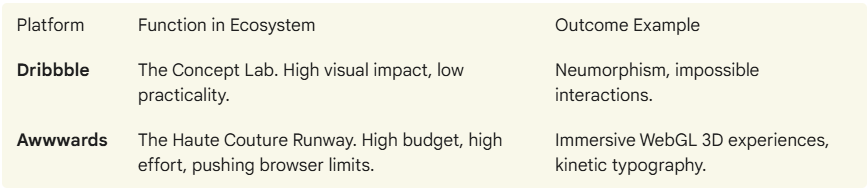
If technology builds the stage, creative communities are where the rehearsals happen. Platforms like Dribbble, Behance, and Awwwards act as highly efficient engines for “mimetic desire”, the psychological phenomenon where we want things because we see others wanting or praising them.
However, it is vital to distinguish between conceptual trends and production trends.
The Dribbble Effect: The “Uncanny Valley” of Design
Dribbble is famous for “eye candy” designs created for likes, not for real users. These conceptual trends often gain massive traction before their practical flaws are realized.
Evidence in Action: The Rise and Fall of Neumorphism (2020)
Neumorphism (a soft, extruded plastic look) became a viral sensation on Dribbble in early 2020. It looked futuristic and tactile in static images.
However, as soon as teams attempted to implement it in real products, it failed dramatically. The style relied heavily on subtle shadows to define buttons, which created severe accessibility issues for visually impaired users and was nearly invisible on low-quality screens. It was a “trend” that burned brightly in the incubator but died in the real world.
3. The Tooling Authorities: We Shape Our Tools, and Thereafter They Shape Us
Marshall McLuhan’s famous adage holds true in digital design. The path of least resistance in popular design software often becomes the dominant aesthetic trend.
If a feature is hard to execute in Adobe Photoshop or Figma, few will do it. If a new update makes a complex effect a single click, it will suddenly appear everywhere.
The “Spline Effect” and 3D Democratization
For years, 3D web elements were rare because the learning curve for software like Cinema 4D was immense.
The rise of accessible, browser-based 3D tools like Spline or Vectary lowered the barrier to entry almost to zero. Suddenly, 2D UI designers could easily create puffy, clay-like 3D icons and abstract shapes. The explosion of “Claymorphism” and playful 3D headers in SaaS websites over the last three years is a direct correlation to the accessibility of these new tools. The trend didn’t exist until the tool made it easy.
4. Socio-Global Pressures: Design as a Mirror
Finally, design reflects global anxieties, economic realities, and paradigm-shifting technologies.
The Sustainability Driver: “Digital Sobriety”
As awareness of the internet’s carbon footprint grows, “Sustainable Web Design” is moving from a niche concern to an aesthetic choice. This is influenced by the World Wide Web Foundation’s sustainability manifestos.
This manifests visually as:
- Dark Mode as Standard: On OLED screens, darker colors consume significantly less energy.
- Low-Data Aesthetics: A return to monospaced fonts, black-and-white imagery, and visible tech brutalism that signals “we aren’t wasting bandwidth on decoration.”
- The AI Paradigm Shift: From Navigation to Intention
The rise of Generative AI is causing the single biggest shift in UI since the invention of the touchscreen. We are moving from a “Command-Based” interface to an “Intent-Based” interface.
In a traditional UI, the user must know where to click to achieve a goal (e.g., Menu > Settings > Account > Update Profile). In an AI-driven “agentic” interface, the user simply states their intent (“Update my profile picture”), and the AI executes it.
This trend is currently minimizing complex navigation bars and replacing them with prominent, central input fields—making the “chatbot prompt box” the defining UI element of this era.
Conclusion: The Diffusion of Digital Innovation
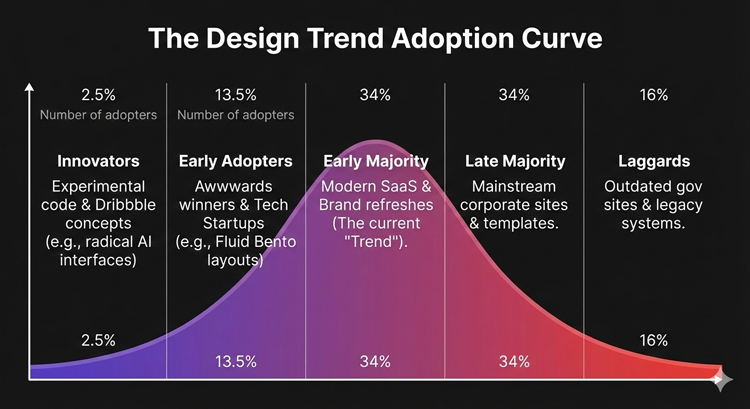
To understand where a trend is in its lifecycle, we can adapt Rogers’ “Diffusion of Innovations” theory to web design.
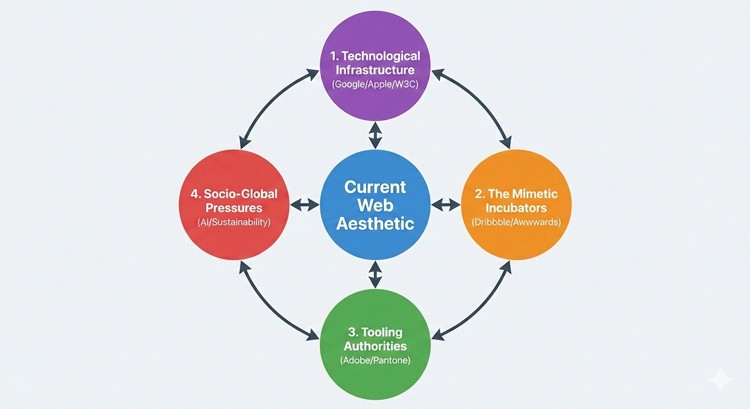
By looking at this ecosystem, we see that trends are rarely accidental. They are solutions to new technological problems, reactions to new tools, or reflections of a changing world.